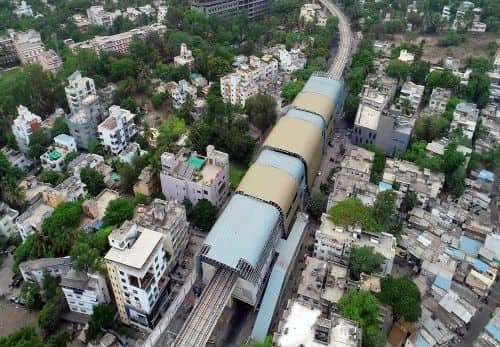
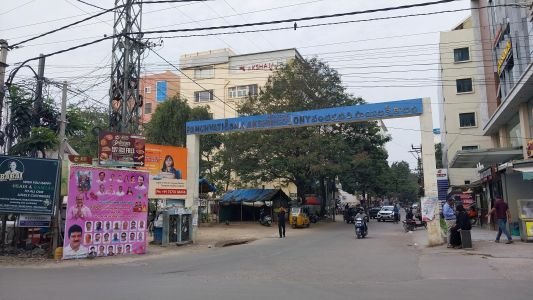
Every city has that one locality where the name outgrows the temple it came from, and in Coimbatore, that’s Saibaba Colony. What began as a residential pocket built around a Sai Baba temple has become one of the city’s most recognisable addresses — upper-middle-class, densely populated, and now increasingly commercial along its busiest stretches. Here’s what actually defines this neighbourhood beyond the name.

Saibaba Colony Overview
| Detail | Information |
| Locality | Saibaba Colony |
| City | Coimbatore, Tamil Nadu |
| Pin Code | 641011 (also 641028, 641034 in parts) |
| Ward | Ward 22 |
| Distance from Gandhipuram | Approx. 4 km |
| Bordering Roads | Thadagam Road, Mettupalayam Road |
| Nearby Localities | R.S. Puram, Coimbatore North Junction, Jawahar Nagar |
| Nearest Railway Station | Coimbatore North Junction |
| Metro Status | No current line; part of proposed Coimbatore Metro network |
The Temple That Named a Neighbourhood
The locality takes its identity from Sri Naga Sai Mandir, a Saibaba temple that first installed the deity’s picture in 1942 before replacing it with a marble statue in 1961. Even in those early decades, it drew thousands of worshippers — and that religious footfall eventually shaped the neighbourhood growing around it. What started as a quiet residential pocket dominated by individual houses began shifting after 2010, when apartment construction picked up pace and the area’s popularity with upper-middle-class buyers grew steadily.
Geographically, Saibaba Colony sits boxed between two of Coimbatore’s major arterial roads — Thadagam Road on one side and Mettupalayam Road on the other — putting it roughly 4 to 5 km north of Gandhipuram, the city’s commercial heart.
Boundaries and Bordering Localities
Saibaba Colony shares direct borders with several well-known Coimbatore neighbourhoods, which matters a lot when comparing property listings or figuring out delivery zones:
- S. Puram — one of Coimbatore’s most established upscale localities, sharing its southern boundary
- Coimbatore North Junction — bordering the colony and home to its own railway station
- Tamil Nadu Agricultural University campus — forming part of the colony’s western edge
- Goundampalayam — a quieter residential neighbour completing the boundary
- Jawahar Nagar and KK Pudur — close enough to be treated as extensions of daily life here for many residents
Getting Around: Roads, Rail, and Bus
Public transport is genuinely one of Saibaba Colony’s stronger points, even without a metro line currently in operation.
- Bus connectivity: The Saibaba Colony Bus Terminus, opened in 2010 on Mettupalayam Road, handles around 10,000 passengers daily and serves as a major hub connecting the locality to the rest of the city and its outskirts.
- Railway access: Coimbatore North Junction sits right at the colony’s border, while Coimbatore Main Junction is also within reasonable reach for longer-distance train travel.
- Road network: NSR Road, running through the heart of the colony, has become almost entirely commercial — lined with retail outlets and shops rather than residences.
- Metro (upcoming): Coimbatore currently has no operational metro, but the city’s proposed metro project — spanning five lines across 147 km with an approved outlay of Rs 9,000 crore for its first phase — is expected to eventually improve connectivity in this belt, though residents shouldn’t factor this into near-term planning.
- Local transport: Auto and cab availability is consistently rated as one of the locality’s practical strengths by residents.
Daily Life: What the Colony Offers
- Bharathi Park and a municipal children’s park, built by the Coimbatore City Municipal Corporation, give residents genuine green space for morning walks — a rarity in such a densely populated pocket
- Schools including Avila Convent and several Corporation Elementary Schools serve local families
- Hospitals such as Rukmani Ammal Hospital and Masani Hospital, both in neighbouring R.S. Puram, are within easy reach
- Popular local dining spots, including well-known restaurants along NSR Road, add to the area’s reputation as both a residential and social destination
- Shopping needs are covered extensively along NSR Road and the surrounding commercial stretches, which have grown dense enough to rival some of Coimbatore’s dedicated shopping districts
A Few Honest Trade-Offs
Living here isn’t without its friction points, and long-term residents are fairly candid about them:
- Traffic congestion is a recurring complaint, particularly along Mettupalayam Road and near the bus terminus during peak hours
- Parking space is genuinely limited given the density of commercial activity packed into a relatively small area
- Ongoing construction in parts of the locality has led to periodic dust pollution, a trade-off of the area’s continued popularity with developers
FAQs
Q1. Is Saibaba Colony primarily residential, or has it become mostly commercial now?
It’s a genuine mix, though the balance has shifted over the years. NSR Road in particular has become almost fully commercial, while the surrounding lanes retain a strong residential character dominated by individual houses and increasingly, apartments.
Q2. How do I reach Saibaba Colony if I’m arriving by train from another city?
Coimbatore North Junction is the closest station, sitting right at the colony’s edge, while Coimbatore Main Junction serves as the city’s primary terminus for longer routes — both are viable depending on which train you’re on.
Q3. Will the upcoming Coimbatore Metro actually improve connectivity to Saibaba Colony, and when might that happen?
It’s expected to help once operational, since the locality currently has no metro access at all. That said, the project is still in its early phases, so residents and prospective buyers shouldn’t count on metro connectivity as a near-term convenience.
Q4. Is Saibaba Colony a good fit for families concerned about traffic and parking, given its popularity?
It’s worth weighing carefully. The locality offers strong amenities, schools, and green spaces, but frequent traffic jams and parking shortages are genuine, recurring issues residents flag — particularly if you’re considering a home directly along or near NSR Road.